- +252 (61) 5825152
- [email protected]
- November 3, 2026 21:41

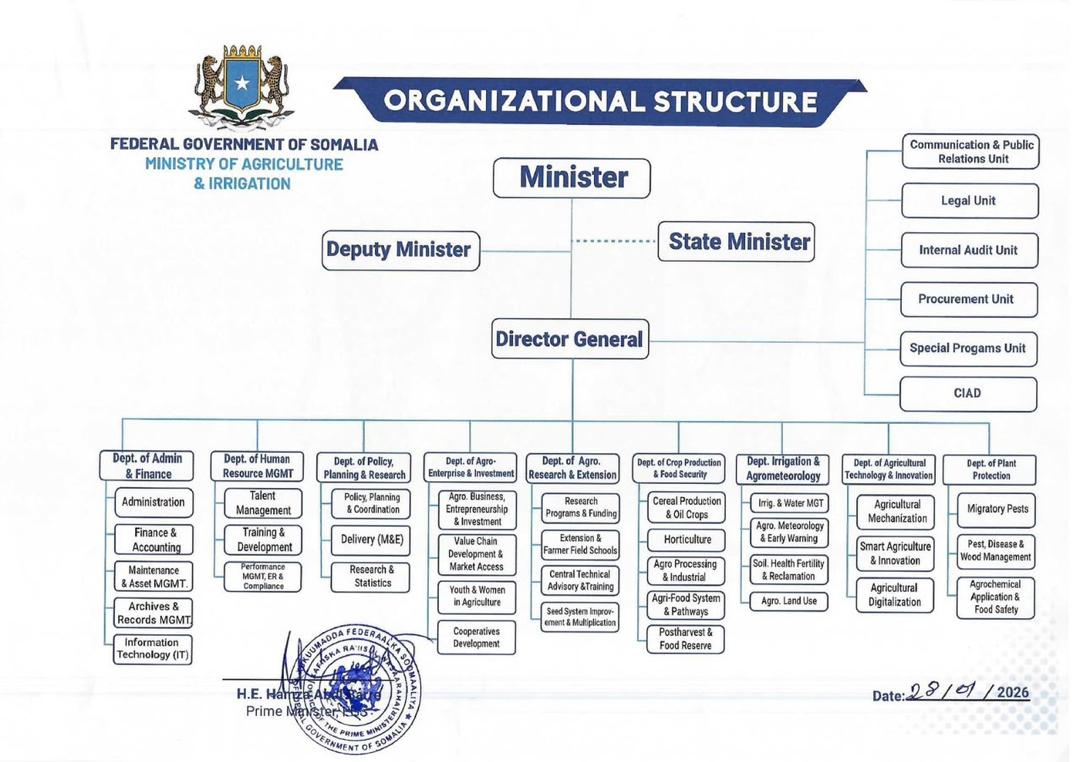
The Department provides national technical leadership to protect crops and plant resources from pests, diseases and harmful weeds, and to improve the health and productive capacity of agricultural soils to ensure sustainable agricultural production and food security. It coordinates surveillance, management, prevention, preparedness, evidence, standards and capacity development. The department also provides training and support to farmers on best practices in plant health and sustainable soil management, contributing to increased productivity and resilience against agricultural threats.
Develop policies, strategies, and technical guidelines for plant protection and soil health.
Monitor and manage crop pests, diseases, and harmful weeds.
Coordinate surveillance and early warning for migratory and transboundary pests.
Promote Integrated Pest Management (IPM).
Promote safe handling, application, storage, and disposal of agrochemicals.
Coordinate soil assessment, sampling, mapping, and research.
Promote soil fertility management and responsible fertilizer use.
Support soil conservation, restoration, and land rehabilitation.
Maintain plant protection and soil health data and information systems.
Provide technical training and advisory services to farmers and stakeholders.
Coordinate research, reporting, partnerships, and technical cooperation.
Support national agricultural resilience and food security initiatives.

To become the primary national institution for pest management without destroying the biodiversity and soil information management.
To lead coordinated, evidence-based plant protection and soil health services through early warning, integrated pest management, safe agrochemical practices, integrated soil management, national soil mapping and sustainable soil interventions, working with farmers, federal member states and partners.